
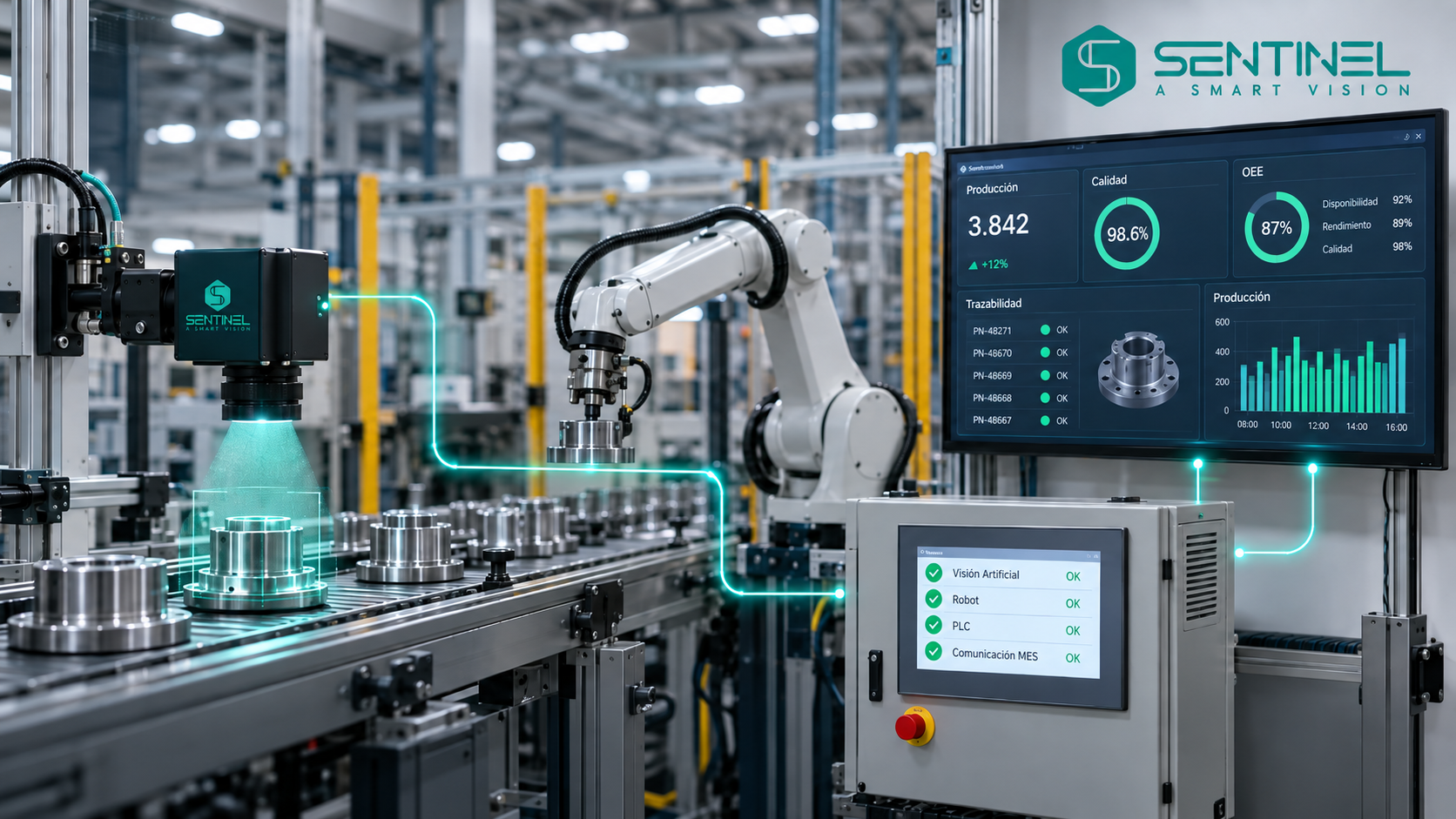
As manufacturing becomes increasingly connected, machine vision is no longer a standalone inspection tool. Today, it plays a central role within automated production environments, communicating with programmable logic controllers (PLCs), industrial robots, and Manufacturing Execution Systems (MES) to support faster decision-making and more efficient production processes.
By integrating machine vision with existing factory systems, manufacturers can move beyond simple defect detection and create intelligent production lines capable of responding automatically to quality events in real time.
Machine Vision as Part of the Production Ecosystem
A machine vision system captures images, analyses them using specialised software or artificial intelligence, and generates inspection results within milliseconds. However, the real value comes from what happens after the inspection.
Rather than simply identifying whether a product passes or fails, the system can immediately communicate the result to other equipment on the production line. This enables automated actions without requiring operator intervention, improving both productivity and consistency.
The three most common integrations are with PLCs, industrial robots, and MES platforms.
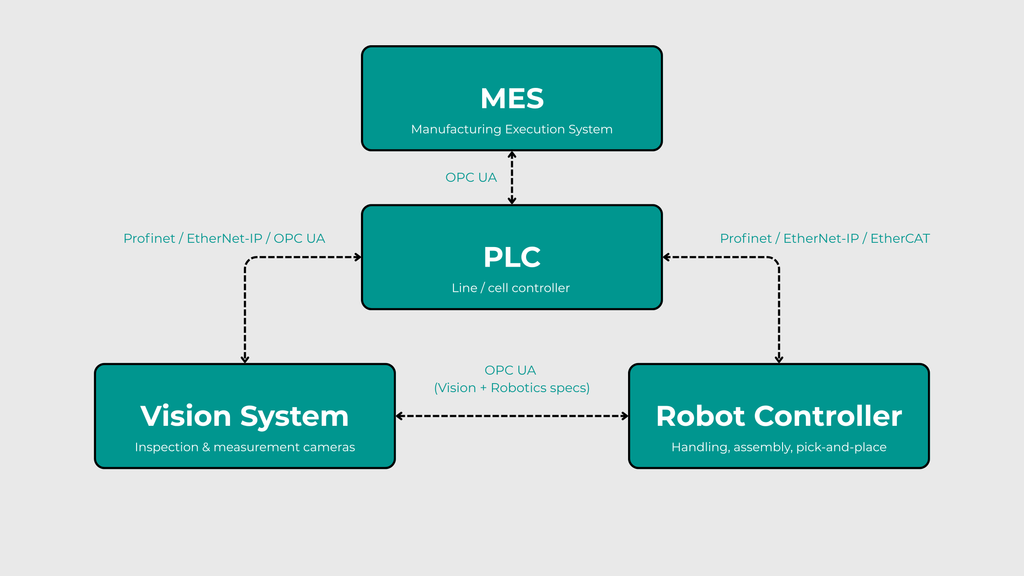
Integrating with PLCs
Programmable Logic Controllers are responsible for controlling many of the machines used in industrial production. They coordinate conveyors, sensors, motors, pneumatic systems, and numerous other devices throughout the manufacturing process.
When integrated with a PLC, a machine vision system can exchange inspection results in real time. Depending on the outcome, the PLC can automatically:
- Reject defective products from the production line.
- Stop production if repeated defects are detected.
- Trigger alarms for operators.
- Activate sorting mechanisms.
- Adjust machine parameters based on inspection results.
- Record production events for further analysis.
Communication has traditionally relied on industrial protocols such as Profinet, EtherNet/IP, Modbus TCP, EtherCAT, or digital I/O, depending on the equipment already installed. More recently, the OPC Foundation and VDMA's Machine Vision working group jointly developed the OPC UA Companion Specification for Machine Vision, giving manufacturers a vendor-neutral information model for exchanging inspection configuration, recipes, and results between vision systems, PLCs, and line controllers — reducing the reliance on the custom, vendor-specific middleware that historically made multi-vendor integration expensive.
This real-time communication helps reduce reaction times while ensuring quality decisions happen automatically during production.
Integrating with Industrial Robots
Industrial robots are widely used for assembly, handling, packaging, welding, palletising, and pick-and-place applications. Machine vision significantly increases their flexibility by providing accurate positional and quality information.
Instead of relying solely on fixed coordinates, robots can use vision guidance to identify the exact location, orientation, or condition of a product before performing a task. Common applications include:
- Picking randomly positioned parts from conveyors or bins.
- Guiding robotic assembly operations.
- Verifying component orientation before assembly.
- Inspecting products before packaging.
- Sorting products based on quality criteria.
- Identifying defective parts for automatic removal.
Demand for this kind of vision-guided automation keeps climbing. According to the Association for Advancing Automation (A3), North American companies ordered 36,766 robots worth $2.25 billion in 2025 — a 6.6% increase in units and a 10.1% increase in revenue over the previous year — with collaborative robots, which rely heavily on vision guidance to operate safely near people, approaching a fifth of all orders. As Jeff Burnstein, president of A3, described it in 2026: machine vision and imaging are "really critical enabling technologies for robots, but also on their own" — increasingly functioning as a single integrated system rather than two separate technologies bolted together.
The safety framework governing this pairing has also evolved. The 2025 revision of ISO 10218 — the core international standard for industrial robot safety — added explicit cybersecurity requirements as they apply to safety, and folded collaborative-application requirements (formerly a separate technical specification) directly into the main standard. It's a clear acknowledgement that vision-guided robots are now full participants on the connected plant network, not isolated machines working in a cell of their own.
By combining robotics with machine vision, manufacturers can automate tasks that would otherwise require continuous manual adjustments or visual inspections.
Integrating with MES Systems
While PLCs control machines and robots perform physical tasks, Manufacturing Execution Systems provide visibility over the entire production process.
Machine vision systems continuously generate valuable inspection data, including pass/fail results, defect types, timestamps, production counts, images, and process statistics. When integrated with an MES, this information becomes part of the factory's digital production records. This allows manufacturers to:
- Monitor quality performance in real time.
- Analyse recurring defects.
- Improve process traceability.
- Generate quality reports automatically.
- Support regulatory compliance.
- Measure production KPIs.
- Identify trends before they become larger quality issues.
Instead of isolated inspection results, manufacturers gain actionable production intelligence that supports continuous improvement initiatives.
The Benefits of Connected Machine Vision
Integrating machine vision with automation systems creates benefits that extend well beyond quality inspection.
Manufacturers can respond immediately to production issues, reduce unnecessary downtime, minimise scrap, improve traceability, and make better operational decisions using accurate production data. Because inspection results are automatically shared across connected systems, manual intervention is reduced and production becomes more predictable, repeatable, and efficient.
At the same time, engineers gain greater visibility into the manufacturing process, allowing them to optimise production based on real operational data rather than assumptions.
North American Robotics Market
Robot orders climbed again in 2025
Demand for vision-guided automation keeps growing across North America — and with it, the case for machine vision that's built to integrate rather than run standalone.
Source: Association for Advancing Automation (A3) — "Robot Orders Grow 6.6% in 2025" (Feb 2026) and "North American Robotics Market Holds Steady in 2024" (Feb 2025). Growth percentages are A3's own year-over-year figures, calculated using a consistent reporting cohort that may differ slightly from the originally published 2024 totals shown here.
Supporting Industry 4.0 and Smart Manufacturing
The integration of machine vision with PLCs, robots, and MES systems is a key element of Industry 4.0 initiatives. Connected production equipment enables factories to collect, share, and analyse information across every stage of manufacturing.
Instead of individual machines operating independently, production becomes a coordinated ecosystem where equipment communicates continuously, allowing quality, automation, and production management to work together.
As artificial intelligence and industrial connectivity continue to evolve, these integrations will become even more important for manufacturers seeking greater flexibility, higher product quality, and improved operational efficiency.
Building a More Intelligent Production Line
Machine vision delivers its greatest value when it becomes an integrated part of the wider manufacturing environment rather than operating in isolation.
"Integration is where a lot of the return on investment actually shows up," says [Name], [Title] at Sentinel Vision. "A vision system that only stops a bad part is useful. One that also tells the PLC to adjust, the MES to log the trend, and the line to keep running — that's what actually changes how a plant operates."
By connecting inspection systems with PLCs, industrial robots, and MES platforms, manufacturers create production lines capable of detecting defects, making automatic decisions, collecting valuable production data, and continuously improving performance.
For companies looking to modernise their operations, this level of integration provides a practical foundation for smarter manufacturing, greater process reliability, and long-term competitiveness in an increasingly automated industrial landscape.
Sources
- OPC Foundation / VDMA — OPC UA for Machine Vision; Vision Systems Design — OPC Machine Vision Part One Officially Adopted; OPC Connect — OPC UA Machine Vision and Robotics Specifications Released
- Association for Advancing Automation (A3) — Robot Orders Grow 6.6% in 2025; Jeff Burnstein interview, Machine Design (2026)
- A3 — Updated ISO 10218 FAQ; ISO — ISO 10218-2:2025
 Would you like to work with the best Artificial Vision experts?