
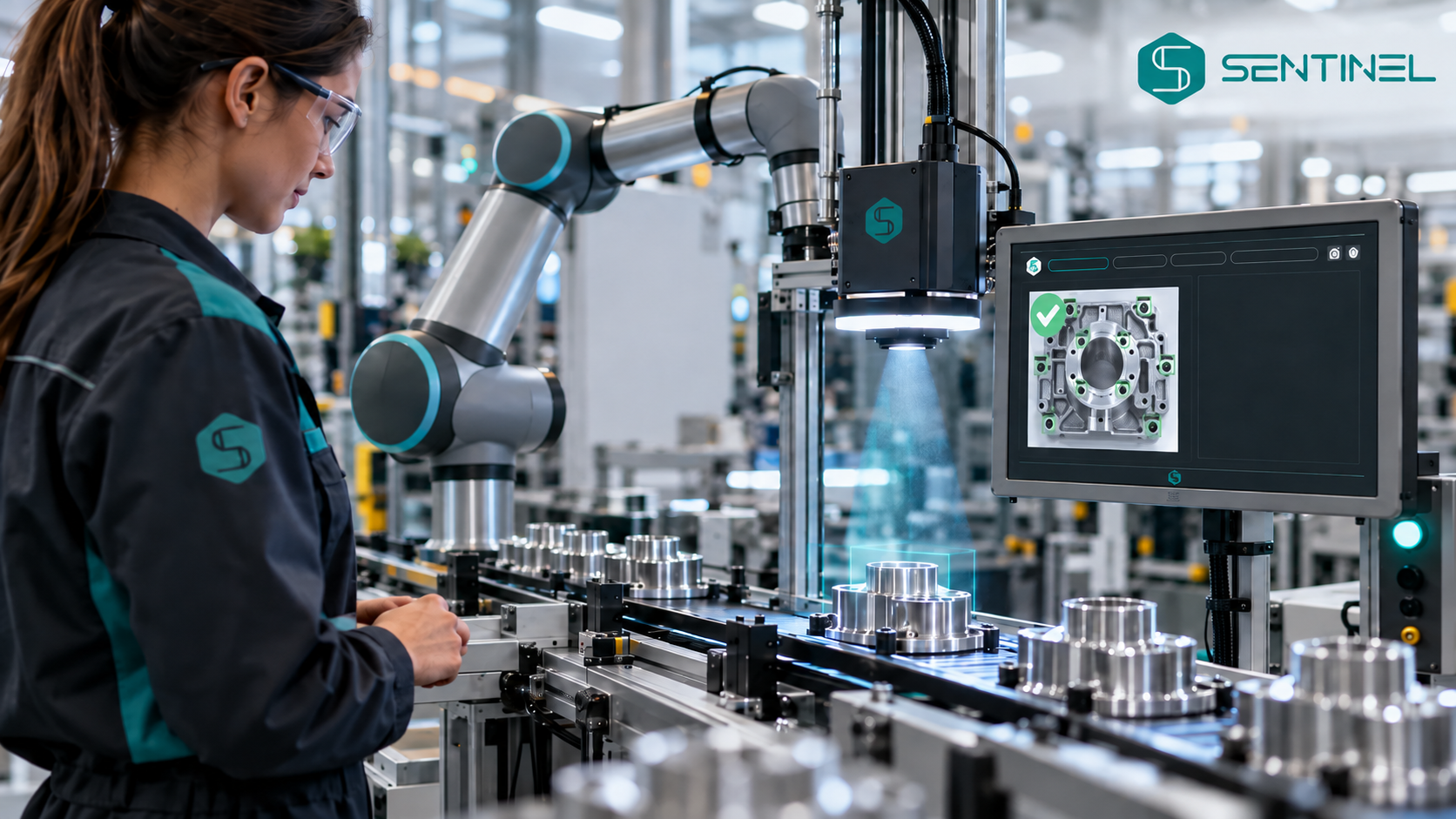
Quality inspection has always been a fundamental part of manufacturing.
For decades, companies have relied on manual checks and traditional automation to ensure products meet customer expectations and regulatory requirements. While these methods have served the industry well, increasing production complexity and higher quality standards are driving manufacturers towards more intelligent inspection solutions.
Today, the combination of Artificial Intelligence (AI), machine vision, and Industry 5.0 is transforming how manufacturers approach quality control. Inspection is no longer limited to identifying defects at the end of a production line. Instead, intelligent systems are becoming capable of detecting problems earlier, learning from production data, and supporting continuous process improvement.
Key Takeaways
- AI adds flexibility beyond rule-based machine vision, but adoption is still early: only ~5% of manufacturing functions had adopted AI as of 2024, per McKinsey.
- Industry 5.0, introduced by the European Commission in 2021, reframes manufacturing around three pillars — human-centricity, sustainability, and resilience — not automation for its own sake.
- The AI-specific segment of the quality inspection market is projected to grow from ~$5.9B (2025) to over $12B by 2030 — faster than the machine vision market as a whole.
- Connecting inspection to PLCs, robots, and MES enables real-time quality decisions — stopping a process the moment an abnormal defect pattern appears, not after a batch ends.
- Earlier, more consistent defect detection directly supports First Pass Yield and sustainability goals by reducing wasted materials, energy, and rework.
In This Article
- From Automated Inspection to Intelligent Inspection
- Why AI Is Changing Quality Inspection
- The Role of Industry 5.0
- Real-Time Quality Decisions
- Data as a Competitive Advantage
- A More Sustainable Manufacturing Future
- Preparing for the Next Generation of Manufacturing
From Automated Inspection to Intelligent Inspection
Traditional machine vision systems operate using predefined rules.
Engineers configure the system to identify specific dimensions, colours, shapes, or defects based on fixed parameters. While highly effective, these systems perform best when inspecting predictable products under controlled conditions.
Artificial Intelligence introduces a new level of flexibility. Instead of relying exclusively on predefined rules, AI-powered vision systems can analyse thousands of product images, recognise complex defect patterns, and improve detection accuracy over time. This makes them particularly valuable for applications where defects are difficult to define using conventional image processing techniques.
As a result, manufacturers can inspect products with greater precision while reducing false positives and missed defects. It's worth noting that adoption of this technology is still uneven: McKinsey's State of AI research found that only around 5% of manufacturing functions had adopted AI as of 2024, even as a smaller group of advanced "lighthouse" factories in McKinsey's Global Lighthouse Network reported substantially improved productivity and defect rates from their AI deployments — a gap that says less about whether the technology works, and more about how early most of the industry still is in adopting it.
AI Vision vs. Rule-Based Vision
Where each approach holds up — and where it doesn't
Rule-based vision is fast and highly accurate on consistent, predictable products. AI-assisted vision gives up a little accuracy in ideal conditions but holds it far better as real-world variation increases. Hover any stage for detail.
Illustrative — see footnoteThis chart is illustrative/conceptual, not measured data. No single published study measures a continuous accuracy curve for this comparison. It visualizes the directional pattern consistently described by machine vision manufacturers — rule-based systems perform strongly on predictable, consistent products but degrade under real-world variability, while AI/deep learning vision tolerates variation with a smaller accuracy drop. Sources: Cognex — Rule-Based vs. AI-Powered Machine Vision; Keyence — Rule-Based vs. AI-Powered Machine Vision Tools.
Why AI Is Changing Quality Inspection
Manufacturing environments generate enormous amounts of visual data every day. AI allows companies to turn that data into valuable insights rather than simply using it for pass-or-fail decisions.
Modern AI vision systems can:
- Detect subtle cosmetic defects.
- Classify different defect types automatically.
- Identify patterns that may indicate equipment wear.
- Adapt to natural product variations.
- Improve inspection consistency across production batches.
- Support predictive quality management.
This is also reflected in where investment is flowing: the AI-specific segment of the quality inspection market is projected to grow from roughly $5.9 billion in 2025 to over $12 billion by 2030, a compound annual growth rate above 15% - notably faster than the machine vision market as a whole, which points to AI increasingly being layered onto existing vision hardware rather than replacing it outright.
AI Quality Inspection Market
The AI inspection market is set to more than double
The AI-specific segment of the quality inspection market is growing faster than the machine vision market as a whole — a sign of AI increasingly being layered onto existing vision hardware, not replacing it. Hover any point for the exact figure.
15.58% CAGR, 2025–20302025 ($5.88B) and 2030 ($12.14B) are Knowledge Sourcing Intelligence's published figures. Years in between are interpolated from the stated 15.58% CAGR, not separately reported by the source — hover each point to see which is which. Source: Knowledge Sourcing Intelligence — AI Quality Inspection Market Size, Share & Forecast.
Rather than replacing traditional machine vision, artificial intelligence enhances its capabilities by making inspection systems more adaptable and capable of handling increasingly complex manufacturing scenarios.
The Role of Industry 5.0
Industry 4.0 introduced connected factories, digitalisation, and automation. Industry 5.0 builds upon these foundations by placing greater emphasis on collaboration between people and intelligent technologies.
The concept was formally introduced by the European Commission in a January 2021 policy paper titled Industry 5.0 – Towards a Sustainable, Human-Centric and Resilient European Industry, which frames the shift as one where industry moves beyond efficiency and shareholder value alone, towards a model built around three pillars: human-centricity, sustainability, and resilience.
As Mariya Gabriel, the EU's Commissioner for Innovation, Research, Culture, Education and Youth at the time, said when the concept launched:
"Now is the time to make workplaces more inclusive" — alongside building more resilient supply chains and more sustainable ways of producing.
Instead of focusing solely on automation, Industry 5.0 aims to combine human expertise with advanced technologies such as AI, robotics, machine vision, and real-time data analytics. Within quality inspection, this means that intelligent systems handle repetitive inspection tasks while engineers and operators focus on decision-making, process optimisation, and continuous improvement.
The objective is not to replace people, but to enable them to work more efficiently using better information and smarter tools.
Real-Time Quality Decisions
One of the most significant developments in modern manufacturing is the ability to make quality decisions while production is still running.
When machine vision systems are connected to PLCs, robots, MES platforms, and production equipment, inspection results can trigger immediate actions without operator intervention. For example, an AI-powered inspection system may detect an abnormal increase in a particular defect. Instead of waiting until the end of a production batch, the system can immediately notify operators, stop the affected process, or automatically remove defective products from the production line.
This proactive approach reduces waste, minimises rework, and helps maintain consistent product quality.
Data as a Competitive Advantage
Every inspection performed by a machine vision system generates valuable production information. Over time, this data becomes one of the manufacturer's greatest assets.
By analysing inspection trends, manufacturers can:
- Identify recurring quality issues.
- Improve production processes.
- Optimise equipment performance.
- Reduce scrap rates.
- Improve traceability.
- Support compliance with industry regulations.
- Make faster, data-driven decisions.
As AI continues to evolve, these systems will become increasingly capable of identifying hidden relationships between production variables that would be extremely difficult for humans to detect.
AI Quality Inspection Market
The AI inspection market is set to more than double
The AI-specific segment of the quality inspection market is growing faster than the machine vision market as a whole — a sign of AI increasingly being layered onto existing vision hardware, not replacing it.
15.58% CAGR, 2025–2030Solid dots (2025, 2030) are independently published figures. Dashed-ring dots (2026–2029) are interpolated from the stated 15.58% CAGR, not separately reported by the source. Source: Knowledge Sourcing Intelligence — AI Quality Inspection Market Size, Share & Forecast.
A More Sustainable Manufacturing Future
Quality inspection also plays an important role in sustainability.
Detecting defects earlier means fewer materials are wasted, less energy is consumed producing defective products, and fewer resources are required for rework or replacement. This connects directly to a metric quality teams already track closely: First Pass Yield, the percentage of units that pass inspection without rework or scrap on the first attempt.
A high-performing line typically holds a First Pass Yield of 95% or above; every percentage point below that represents wasted materials, energy, and labour that earlier, more consistent detection can help recover.
By improving first-pass yield and reducing unnecessary production losses, AI-powered machine vision contributes to more efficient manufacturing operations while supporting environmental and economic sustainability goals. These improvements align closely with the broader objectives of Industry 5.0, where technological innovation is expected to create not only more productive factories but also more sustainable and resilient ones.
Preparing for the Next Generation of Manufacturing
Artificial Intelligence, machine vision, and Industry 5.0 are not distant concepts — they are already shaping modern production facilities across industries including automotive, electronics, pharmaceuticals, food and beverage, medical devices, plastics, and advanced manufacturing.
As customer expectations continue to rise and production becomes increasingly complex, manufacturers that invest in intelligent inspection technologies will be better positioned to improve quality, increase efficiency, and remain competitive in a rapidly evolving industrial landscape.
"We tell clients not to think of AI vision as a replacement for their existing quality process, but as a way of finally giving that process the consistency it was always supposed to have," says [Name], [Title] at Sentinel Vision. "The factories getting the most value from it are the ones that kept their people closely involved in defining what 'good' looks like."
The future of quality inspection is no longer based solely on detecting defects. It is about creating connected, intelligent manufacturing systems that continuously learn, adapt, and improve. By combining AI, machine vision, and Industry 5.0 principles, manufacturers can move beyond traditional quality control and build production environments that are smarter, more efficient, and prepared for the challenges of tomorrow.
Sources
- Quality Magazine — AI in Quality Management: Hype vs. Reality (citing McKinsey's State of AI and Global Lighthouse Network research)
- Knowledge Sourcing Intelligence — AI Quality Inspection Market Size, Share & Forecast
- European Commission, Directorate-General for Research and Innovation — Industry 5.0: Towards More Sustainable, Resilient and Human-Centric Industry; Industry 5.0 policy report
- MRPeasy — What Is First Pass Yield and How to Improve It?
Note: adoption and market figures shift quickly in this space — recommend a quick data refresh before publishing if this article goes live more than a couple of months after drafting.
 Would you like to work with the best Artificial Vision experts?